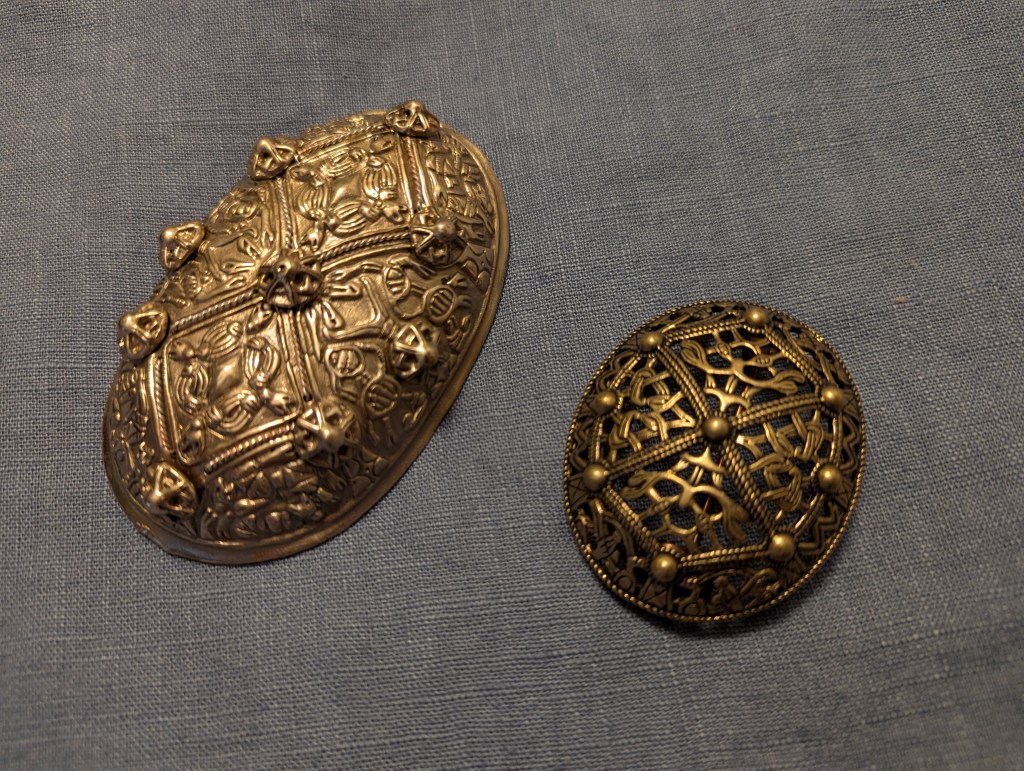
My first pair of tortoise brooches were replicas of a relatively simple oval brooch type R-657 that had been found all over Northern Europe, including 9th/10th century Denmark. The artisan had reproduced them slightly smaller (6 cm) than the original size (9 cm), which, in my opinion, worked well with my kit at that time. The only concern I had when wearing those brooches was that they always seemed to drop to one side instead of laying flat on my chest.
When I started creating a fancier dress, I realised that larger tortoise brooches would be more appropriate for my updated kit. This time I did some more research and obtained highly accurate reproductions of 10 cm long oval tortoise brooches of type P-37/R-647 that had been excavated in multiple locations, including Hedeby (e.g., grave 109/1959). Upon unwrapping this gift to myself, I first noticed how heavy they were and got worried that they would pull down my aprondress. I also noticed that the needles were positioned inside the cavity of the brooches, which is very different to the positioning of the needles in my first set of brooches (see picture below).

When I finally put on my new brooches, I was absolutely stunned by their excellent fit. They laid flat on my chest and kept my aprondress right where it was supposed to sit. These tortoise brooches didn’t wobble from one side to the other at all. I shared my observation with two friends: one, who was wearing a different pair of large tortoise brooches made by the same artisan, and another, who was wearing the identical smaller tortoise brooches I had bought as my first pair. The first friend had shared the same concerns about the weight of the tortoise brooches and found that to be of no issue either. Her brooches fit as nicely as mine. My other friend with the smaller brooches, however, mentioned that her brooches were a bit wobbly… How interesting! It took me a while to realise that this was most likely because of the needle positioning. The size and shape of the tortoise brooch replica (or my body shape, for that matter) may have nothing to do with the wobbling.
Now, my interest was provoked, and I tried to find out how needles were positioned in the original tortoise brooches uncovered in excavations. This turned out to be a tricky undertaking because, at least online, brooches are usually depicted from the front only. Luckily, Hägg (1991) has published several photographs and drawings of tortoise brooches with needles, including a picture of the brooch I got a replica of. In all these depictions, the needles are attached to the inside of the brooch’s cavity, as in the replicas I recently obtained. Update from June 11th: The online Collection of the British Museum shows several tortoise brooches pictured from the reverse side.
Next, I turned to online shops that sell tortoise brooch replicas. I found that not all shops show the reverse side of a tortoise brooch replica, which makes it almost impossible to tell how the needle is positioned. Sometimes, you can see that a tortoise brooch replica is lying flat on the surface or tilted slightly to the side, the latter most certainly indicating a raised needle position. Knowing what I know now, I wouldn’t buy a tortoise brooch replica without seeing a picture of the back (and possibly side) that clearly showed the desired setback of the needle into the brooch cavity.
Did you have a learning experience when wearing tortoise brooches? I love hearing other people’s observations when using artifacts from the past, no matter how small or random.
Sources
Hägg, Inga. (1991). Die Textilfunde aus der Siedlung und aus
den Gräbern von Haithabu. Karl Wacholtz Verlag, Neumünster, Germany.
Tortoise brooch replica type P-37 / R-647: https://szepczacekruki.pl
Tortoise brooch replica type R-657: https://northerntraders.es

 Norsefox
Leave a comment