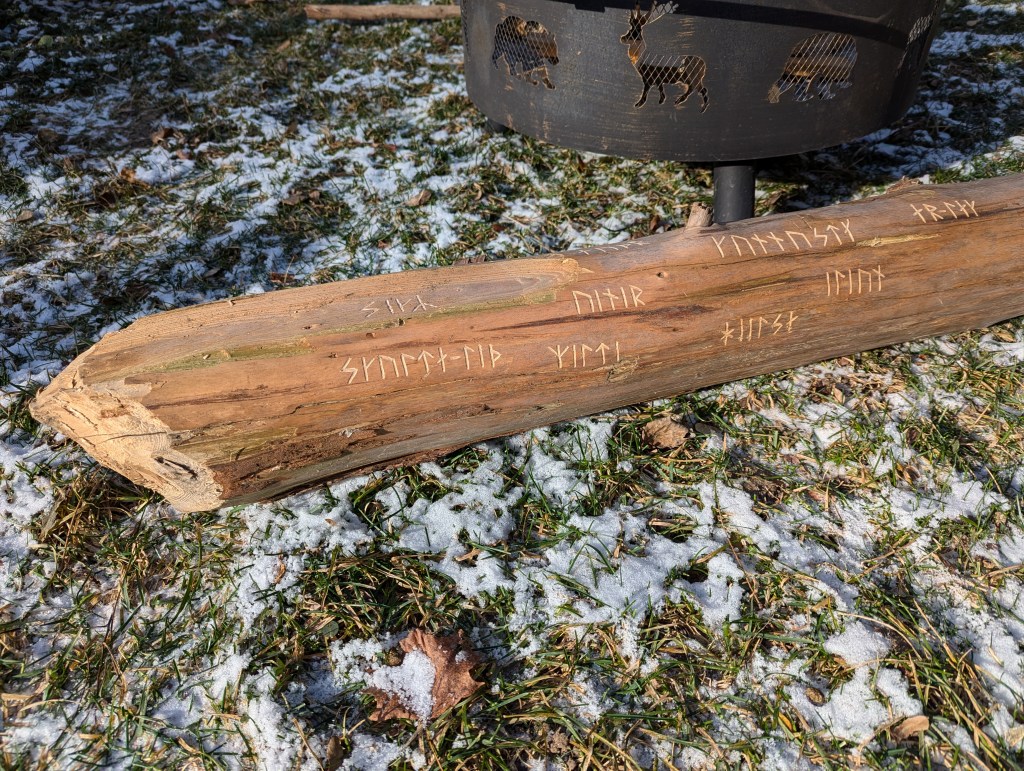
This year’s Winter Solstice presented me with the opportunity to carve our group’s good wishes into a Yule log. I had recently become more interested in runes. Growing up, I was taught the Elder Futhark, which is the alphabet most people are familiar with, as they provide runes for almost all letters of the Latin alphabet. Transcription is fairly straight forward, and I enjoy seeing visitors at our events engage with the runes of the Elder Futhark when they write their names.
However, the Elder Futhark is not the rune alphabet that the early medieval Scandinavians used. Not being a studied historian and learning these things only in my spare time, I stumbled over the very much reduced set of runes of the Younger Futhark when trying to decipher a rune stone last year. Intrigued, I started to read a bit more about the differences between those two alphabets. Now, my studies on runes have not progressed very far, but given the focus on 9th and 10th century Hedeby (then Denmark) of my reenactment, I understood that I would need to take a closer look at the long-branch and short-twig runes of the Younger Futhark (Imer, 2014).
Runes provide a phonetic transcription for sounds and one rune can represent multiple sounds (Price, 2022). Consequently, it is possible to write English words and names with the Younger Futhark, it just requires a little bit more out of the box thinking. For example, the rune ᛁ can be used for the sounds corresponding to i, j and e. For our Yule log, I decided to search for the Old Norse equivalent of the words my peers wished to see on the log. Luckily, knowledgeable people compiled an Old Norse Dictionary that was of tremendous help. I also cross-referenced words with saga verses and a cute little book called “Old Norse for Modern Times” by Ian Stuart Sharpe to come up with the most fitting translation. Altogether, it was a fun exercise that deepened my interest in the Younger Futhark, as well as the Old Norse language.
Here’s the list of good wishes for the new year, both in English, Old Norse and Younger Futhark (without any guarantees for correctness – feel free to leave better fitting suggestions in the comments).
- Peace – frið – ᚠᚱᛁᚦ
- Joy – gleði – ᚴᛚᛁᚦᛁ
- Travelling – fara – ᚠᛅᚱᛅ
- Light – bartleikr – ᛒᛅᚱᛏᛚᛁᛁᚴᛦ
- Knowledge – kunnusta – ᚴᚢᚾᚾᚢᛋᛏᛅ
- Prosperity – auðr – ᛅᚢᚦᚱ
- Friend – vinir – ᚢᛁᚾᛁᚱ
- Grace – mildi – ᛘᛁᛚᛏᛁ
- Hope – von – ᚢᚢᚾ
- Success – sigR – ᛋᛁᚴᚱ
- Health – heilsa – ᚼᛁᛁᛚᛋᛅ
- Fortune – happ – ᚼᛅᛒᛒ
- Patience – eljun – ᛁᛚᛁᚢᚾ
- Family – skulda-lið – ᛋᚴᚢᛚᛏᛅ-ᛚᛁᚦ
- Destiny – ørløg – ᛅᚱ-ᛚᛅᚴ
Happy Solstice to you all!

Sources
Imer, Lisbeth M. (2014). The Danish runestones – when and where? Danish Journal of Archaeology, Vol. 3, No. 2, 164–174.
Price, Neil. (2022). Children of Ash and Elm. Basic Books, New York, USA.
 Norsefox
Leave a comment